Sarah Perry

Combining a love of people and words and calling it journalism.

To Spit or to Swallow?

When I first learned about wine tasting, I was appalled to hear that some people spat out the wine. They take a sip, swirl it around in their mouths, and spit it in a perfect ruby-red arc, right into a bowl.

What a waste.

When my friend Mike lent me a book on wine for my trip, I was determined to figure out why people spit out such goodness. Mike’s brother spits, he swallows. Apparently, some people want to keep a “clear head” when they taste.

I flipped through the pages of Discovering Wine, written by Joanna Simon, and wondered how I could spit as gracefully as she did in her pictures. Joanna recommends practicing in the bathroom when you’re brushing your teeth so you won’t be “embarrassed by your spitting image” – after all, she writes, “spitting is the done thing.”

I gathered the foamy toothpaste in my mouth and lined up my mouth with the sink. Head held high, I puckered my lips and thrust my tongue forward. My black T-shirt had a beautiful arrangement of white foam right across my breast.

When I arrived in the tasting rooms, I warned the staff of my handicap. “I’m a terrible spitter,” I told them.

Pamela Palmer at Fiasco just laughed. Brooke at Reininger said she doesn’t spit, either.

When I tasted B Cellars’ 2006 To Kalon Cabernet, there was no way that wine was going into a bowl.

As my friend Jeff Prince puts it, “Spitting out a perfectly good wine seems wasteful. Besides, I never liked seeing a woman spit.”
For the Love of the Grape

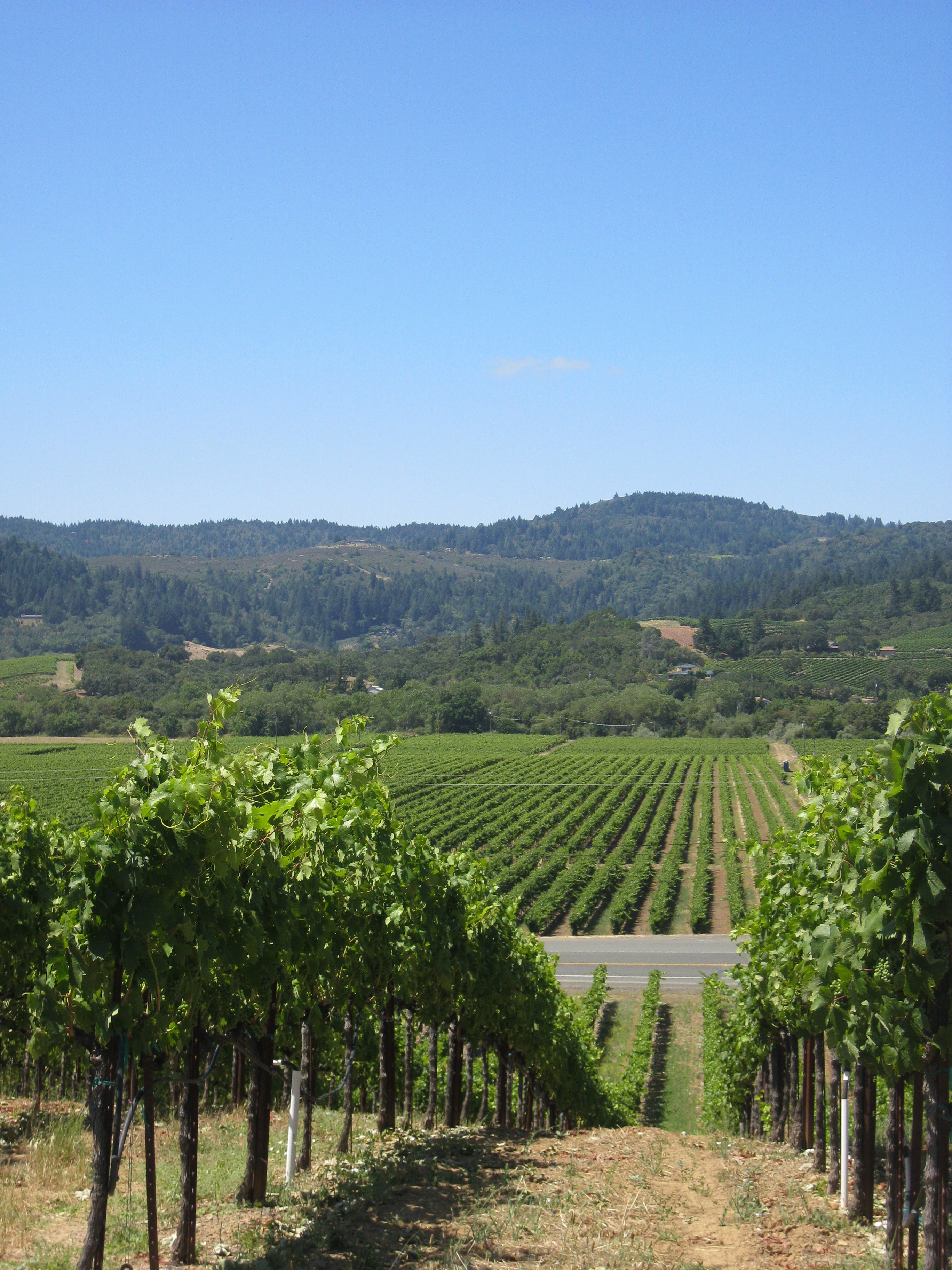
Rows of grapes in Dry Creek Valley

Grapes are a finicky fruit. They like certain temperatures, can’t get too hot, can’t have too much water, can’t be ripe too long, like shade on a certain side. The list goes on. Their vines love to mold, bugs love to feast on their buds. They remind me of some persnickety elderly people I’ve served – the old man banging the coffee cup on the table, always demanding something.
Needless to say, it’s always tough for vintners to produce a quality grape. There are years like 06 and 07 that come once a decade or so. There’s last year when the vineyard managers scurried to do an early harvest because of all the rain in the forecast. There are years when you sacrifice tons of so-so fruit to produce a stellar, quality vintage.

Whatever year it is, the grapes and wine are never the same. That constant shifting is what attracts so many people to the profession (they prefer to call it a lifestyle). Scott and Lynn Adams of Bella Winery, Jim Borsack and Duffy Keys of B Cellars, Dave and Pamela Palmer of Fiasco – they all say it’s the change they love. These three are all in different areas – B Cellars crushes fruit in the legendary Napa Valley, Bella is nestled in the rolling hills of Sonoma’s Dry Creek, and the Palmers prune their vines in the mountains of Jacksonville, Oregon.  They all had different careers, discovered wine, caught the bug and changed their lives to acclimate their passion. Lynn worked in merchandising, Jim in high-end luggage and Dave was a pilot for FedEx. They all made sacrifices and took a chance on a new career move.

There will always be the Mondavis and Beringers of Napa Valley, but these folks and lots of others like them, from Jacksonville, Oregon all the way to Walla Walla, Washington, are determined to leave their mark on the wine industry.

Now, if only those grapes would behave.

California Dreamin’

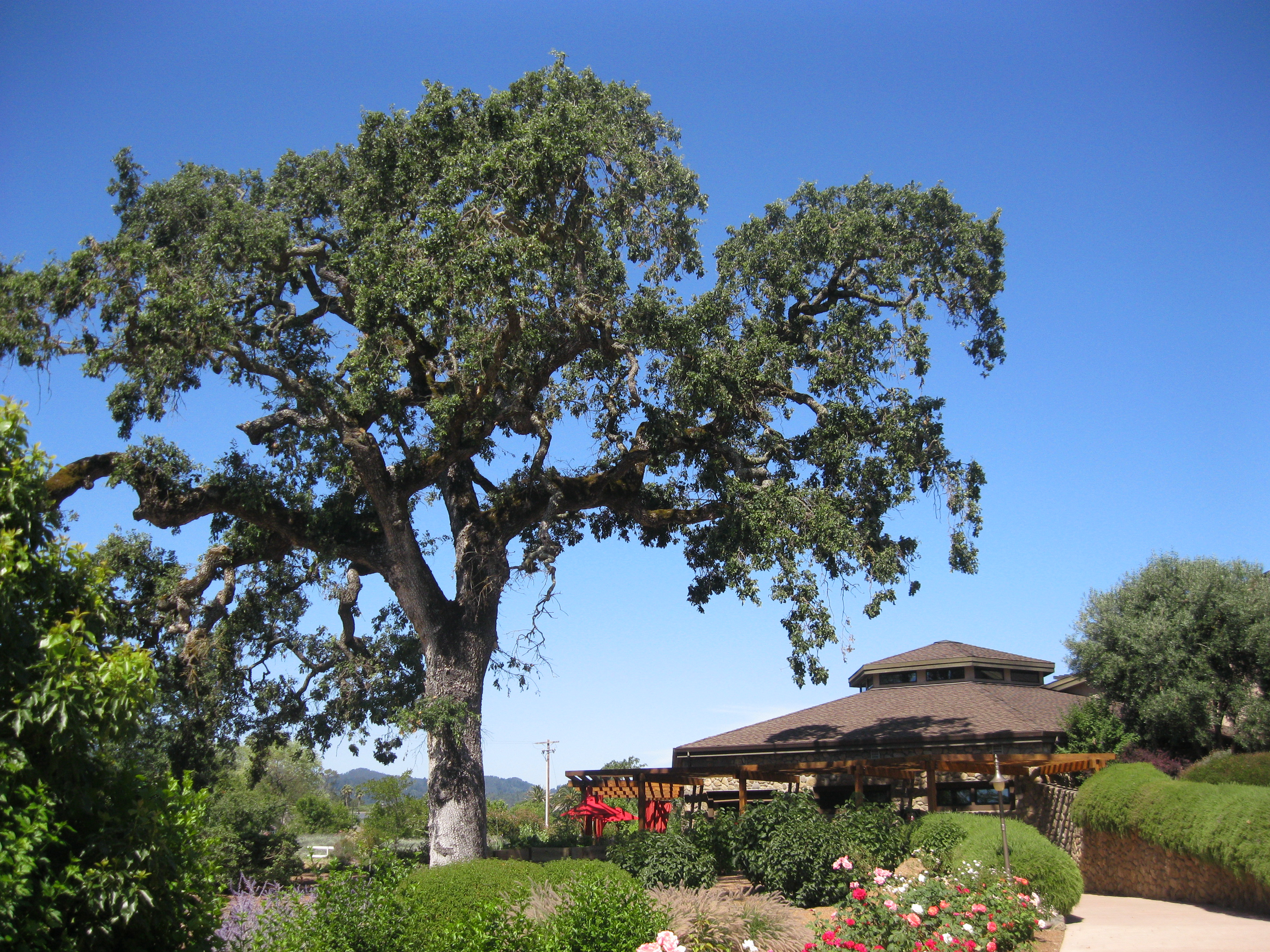
B Cellars in Napa Valley

California. Redwood trees, wine and plastic people. That’s what I always thought of when I heard the state mentioned. Of course, I could never forget Arnold Schwarzenegger. But when I landed in San Jose on Monday, I quickly figured out all my assumptions about The Golden State were wrong.

I’m here to write about one of my assumptions – wine. For a few years, I’ve been obsessed with the cabernets, merlots and pinot noirs that come from the Napa Valley region. I worship Beaulieu Vineyards and would gladly shine any Mondavi’s shoes. I want to crawl inside Andy Beckstoffer’s head (the new king of Napa Valley) and learn his grape-growing secrets, and I’d love to pick the grapes from his To Kalon vineyards.

For years, I’d thought of wine as a status symbol that someone achieves with a certain level of success. You can recognize the oaky flavors or the slight hint of cinnamon and nutmeg in a good wine – if you’ve achieved enough, I’d always thought. Someone’s palette wasn’t enriched with the experience of tasting wine, but with the experience of living the good life, in my imagination. Boy, was I wrong.

As soon as I arrived at B Cellars and began interviewing the assistant winemaker and tasting tour guide, I knew all my assumptions about wine were naïve. Laura, my tour guide, was quick to tell me that any person could have a bad or good experience with the finest or worst of wines – it all depended on what the person likes, and that’s okay. If someone enjoys a $5 bottle of Sutter Home from the gas station, hey – that’s all right. Wine is flexible, and meant for people to enjoy in different environments. You don’t have to be a millionaire or in a wine club to appreciate a good bottle, and it’s okay if you think that $100+ bottle of aged perfection tastes like dog doo. It’s all up to you.

On a different note, the owners of B Cellars, Jim Borsack and Duffy Keys, are entrepreneurs at their prime. They left their long-time careers in high-end luggage and the luxury hotel business, respectively, to pursue their passion with wine. They blend the best grapes they can buy, and a few years ago, acquired the coveted grapes from Beckstoffer’s To Kalon, and created a smooth, spicy blend that Jesus would sin for. They’ve got one of the best wine makers in the valley, and in a few years, I predict they’ll be as well-known as Mondavi for their wines.

How’s that for busting assumptions?